The best 640 thermal scope is the one that actually uses all those pixels — clean sensitivity, a big lens to feed them, and processing that keeps the image sharp when you zoom. That scope is the ATN ThOR 6 640x512. A 640 sensor packs four times the dots of a 384 core, which is the whole point of buying up: you can push magnification and still tell a coyote from a stump at distance. But a 640 sensor alone doesn't guarantee a great scope — bolt it behind a small lens or a sloppy processor and you waste the resolution. This guide explains what a 640 sensor really gets you, what has to sit behind it, and names the ThOR 6 640 as the top pick, with the LRF version for hunters who want ranging built in.
Best 640 with ranging built in: ATN ThOR 6 LRF 640x512 — adds a laser rangefinder and ballistic calculator.
Longest reach: both hit 3650m detection with the 50mm lens.
Best clarity in bad air: ThOR 6 640 at <=15mK for fog and humidity.
Why ATN's 6th-gen 640 sensor is worth the step up
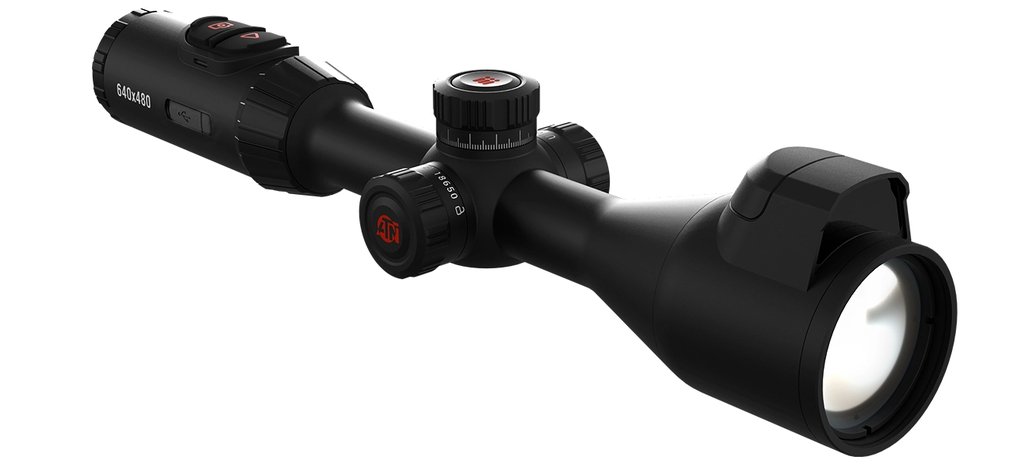
A 640x512 sensor is the reason this scope resolves game where a smaller sensor quits. Think of resolution like an HD screen versus a standard one. A 384x288 core paints a distant coyote with a handful of coarse dots; enlarge it and those dots grow into visible blocks, and you end up staring at a warm smudge trying to decide whether it's an animal or a fence post. A 640x512 sensor lays down roughly four times as many dots across the same field of view — 640 across and 512 tall instead of 384 by 288 — so the same coyote is drawn with four times the information. Legs, ears, the line of the spine and the way it's moving all survive being magnified. That is the entire reason to pay for a 640: not a bigger number on a box, but a picture that stays a picture when you push it.
That extra detail matters most when you zoom, because zoom is where cheaper scopes fall apart. The ThOR 6 640 runs 3-24x optical magnification, and the extra pixels mean the picture holds its shape all the way up instead of collapsing into a grid of squares near the top. Then it stacks up to 8x digital zoom on top of that optical range. Digital zoom is really just cropping into the sensor and enlarging what's there, so it only looks clean when there are enough pixels to crop into — which is exactly why it works far better on a 640 than on a 384. On the 640, a modest push of digital zoom on top of high optical magnification stays usable for confirming what you're looking at; overdo it on any sensor and the image softens, so the trick is treating digital zoom as the last little nudge to identify a target, not as a way to invent range that isn't there.
None of that resolution means anything without something to feed it. ATN pairs the sensor with a 50mm F/1.0 germanium objective, and the lens is doing the heavy lifting most buyers overlook. Thermal cameras don't collect visible light — they collect infrared energy radiating off warm bodies — and a larger objective gathers more of that faint signal and lands it on the sensor. More signal per pixel means a distant, low-contrast animal registers instead of vanishing into the background, which is how the scope stretches its detection range out to 3650m. Detection at that number means the scope can pick up that there is a heat source out there; it is not the distance at which you can identify or ethically shoot the animal, which is always closer and depends on the target's size, the weather and the palette you've chosen. The 640 sensor is what carries you from 'something's warm out there' toward 'that's a hog, facing left' at a longer distance than a 384 could.
On top of the optics, ATN's SharpIR AI processing works on the live image itself. Thermal footage tends to look soft because heat bleeds at the edges of a warm object, and SharpIR pulls those edges back in — tightening the outline of an animal against cooler ground so it reads as a defined shape rather than a fuzzy glow. Feed that cleaned-up image to a Full-HD OLED display running a 50 Hz refresh and the result is a picture that stays crisp and smooth even when the animal is trotting at high magnification. Add <=15mK sensitivity, which measures how small a temperature difference the scope can tell apart, and every one of those 640 pixels earns its keep. That combination — big sensor, big lens, clean processing, fast display — is what makes it the best 640 pick rather than just a 640 on a spec sheet. Plenty of scopes claim the resolution; far fewer build the rest of the optic to match it.
Best 640 overall: ATN ThOR 6 640x512
The ATN ThOR 6 640x512 is the 640 scope to buy if you want the sharpest all-round image without extras you may not use. Its 640x512 sensor and 50mm lens combine for a detailed picture that stays usable across the whole 3-24x range and out to a 3650m detection distance. The <=15mK NETD keeps contrast strong when the air turns humid or foggy, and the 50 Hz refresh keeps a trotting coyote smooth instead of smeared.
Where the resolution pays off
On open ground, the difference shows the moment you crank magnification. Where a 384 scope would give you a warm blob at high zoom, the 640 sensor still shows you the animal's outline — legs, head, direction of travel — so you can make an ethical call before the trigger. That extra certainty is the core value of a 640 sensor, and this scope delivers it end to end. It's the difference between guessing and knowing at 200-plus yards in the dark.
Picture a long fence-line on the edge of a cut field in the small hours. Something warm is working the treeline a couple hundred yards out. Through a 384 scope at the magnification that distance demands, it's an amber lozenge — you can tell it's alive and roughly how big, but not whether it's a coyote you can take, a stray dog, or a deer you can't. Through the ThOR 6 640, the same shape resolves: the tuck of the tail, the low predatory carriage, the ears, the direction it's slinking. The extra pixels are the difference between lowering the rifle because you weren't sure and taking a confident, ethical shot because you were. That is the exact situation a 640 sensor is built for, and it's where the price difference over a 384 justifies itself in a single night.
The tools that come with it
The ThOR 6 640 carries the full 6th-gen feature set: six color palettes so you can match the view to your background, Picture-in-Picture for a magnified aiming window that doesn't cost you situational awareness, Hot Point Tracking to hold a marker on a moving target, Recoil Activated Video to capture your shots hands-free, and Zeroing Freeze to make sighting in straightforward. Each of these is built to protect the picture the 640 sensor gives you — Picture-in-Picture lets you hold high magnification on the target while a small inset keeps the wider scene visible, so you don't lose an animal that steps out of a tight, zoomed frame, and Hot Point Tracking keeps a mark pinned to a mover so your eye isn't hunting for it against a busy thermal background.
Holds up on the long, wet night
A high-resolution sensor is only useful if the scope survives the conditions you take it into, and predator work happens on the worst nights — damp, cold, sometimes in drizzle. The ThOR 6 640 is rated IP67, which means it shrugs off rain and heavy dew rather than fogging up or dying at the worst moment. It draws power from dual 18650 batteries for around 9 hours of runtime, which is a genuine dusk-to-dawn session rather than a couple of hours before you're hunting for a charger. And because 18650 cells are a standard, swappable format, carrying a charged spare set means you can top up in the field and keep the scope running through a second half of the night. Waterproofing and real battery life aren't glamorous specs, but they're what let the 640 sensor actually earn its keep across a full sit instead of on paper.
Capture the shot for later
Recoil Activated Video is more than a novelty. When the rifle fires, the scope automatically records a clip around the shot, so you don't have to fumble for a record button in the dark or decide in advance which encounter is worth filming. That footage is useful well beyond bragging rights — it lets you review your shot placement honestly, confirm a hit or a miss when the animal runs off into cover, and settle exactly what happened on a night that got busy. Pull the files off later and you have a record of every shot from a full-resolution 640 image, not a grainy afterthought. For hunters logging problem-animal work on a property, that built-in documentation is quietly one of the more practical features on the scope.
Who it's for and who it's not
It's for the hunter who works fields, pastures and cut-overs and wants maximum clarity at range from a rugged, waterproof scope. It's not for someone who never shoots past close cover — that hunter can save weight and money with a 384 scope. And if you want ranging built in, read on.
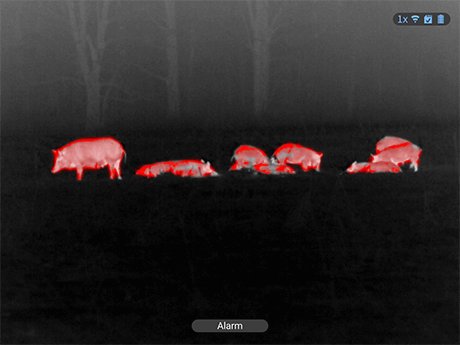
Best 640 with ranging: ATN ThOR 6 LRF 640x512
The ATN ThOR 6 LRF 640x512 is the same excellent 640 sensor with a built-in laser rangefinder added. It ranges out to 1000m with +/-1m accuracy through an eye-safe 905nm Class 1 laser, and feeds that distance into a ballistic calculator with up to 6 profiles. On a long field shot, that means you range the animal and get a corrected aiming solution without taking your eye off the target or reaching for a separate device.
Why ranging matters at 640 distances
A 640 sensor lets you take shots far enough out that bullet drop becomes a real factor. A bullet doesn't travel in a straight line — it falls the whole time it's in flight, and the farther the target, the more it has dropped by the time it arrives. At the close distances a lower-res scope limits you to, that drop is small enough to ignore. At the ranges a 640 opens up, guessing the distance wrong by even a little sends the shot high or low, and 'a little' is easy to get wrong by eye in the dark across featureless ground. The built-in rangefinder removes that guesswork. It reads the target with an eye-safe 905nm Class 1 laser out to 1000m with +/-1m accuracy, so you're working from a real number, not an estimate.
The workflow is what makes it worth the extra hardware. You put the reticle on the animal, press the range button, and the scope returns the distance. That distance feeds straight into the onboard ballistic calculator, which knows your load's trajectory and computes the corrected point of aim — then sends that solution to the display so your holdover is already accounted for. Range, solution, aim: three steps that happen without your eye leaving the target or your hand reaching for a separate device in the dark. Storing up to 6 profiles means the calculator can hold the trajectory for different loads or different rifles, so you switch setups and the math stays correct for each. On the ground where a 640 scope shines, that integration turns long shots from hopeful into repeatable.
The trade against the standard 640
You add a small amount of weight — 855 g versus 830 g — and it steps up in price for the ranging hardware. The image quality, detection range and sensitivity are identical, so the decision is purely about whether you want integrated ranging. Who it's not for: hunters who already carry a separate rangefinder and shoot at known distances; they can skip it and pocket the savings.
How to choose a 640 thermal scope
With a 640 sensor already sorted, the choices are about how you feed and use it. This is the point most buyers miss: two scopes can both say 640x512 on the box and perform nothing alike, because the sensor is only one part of the chain. A high-res core behind a small lens, a slow processor or a low refresh rate throws away the resolution you paid for — you get the pixels but not the picture. So once you've decided on 640, judge the rest of the optic honestly against the way you actually hunt: the distances you really shoot, the weather you shoot in, and how much a moving target figures into it. Weigh these in order:
- Lens size drives range — a 50mm objective gathers more signal than a small lens, which is why both picks reach 3650m. Don't pair a 640 sensor with a tiny lens; you'll starve it.
- NETD sensitivity — lower mK means cleaner contrast in fog and humidity. Both ThOR 6 640 options sit at <=15mK, near the top of the line.
- Refresh rate — 50 Hz keeps moving game smooth. Anything slower smears fast animals at high zoom, which wastes the resolution you paid for.
- Ranging — decide whether you want a built-in laser rangefinder. The LRF version bakes it in; the standard 640 keeps things lighter and cheaper.
- Processing and display — SharpIR AI enhancement and a Full-HD OLED display make the 640 sensor look its best. Both picks include them.
- Build and battery — IP67 waterproofing and around 9 hours of runtime mean the scope survives the long, wet nights where a 640 earns its keep.

How we picked these ATN 640 thermal scopes
We looked only at ATN's current 6th-gen ThOR line and ranked its 640x512 options on the things that let a high-resolution sensor actually perform. Resolution came first, but never in isolation — we weighed lens size, because a 50mm F/1.0 objective is what feeds a 640 core enough infrared signal to reach out to 3650m; NETD sensitivity, because <=15mK is what keeps contrast alive in fog and humidity where a coarser scope goes flat; refresh rate, because 50 Hz is what keeps a running animal smooth at the high magnification a 640 invites; and how well the picture holds up under zoom, since that is the whole reason to buy the extra pixels in the first place. We also gave weight to the processing and display — SharpIR AI and the Full-HD OLED panel — because a clean sensor still needs a clean pipeline to the eye.
The honest trade-off is weight and price. A 640 scope with a 50mm lens is a heavier, more expensive instrument than a 384 rig at 830 g, and the LRF version adds a little of both again — 855 g and the cost of the rangefinder hardware — for the ranging it bakes in. Neither is the right buy for everyone. This is an in-house comparison of ATN's own scopes rather than an independent lab test, so treat these picks as our reasoned read of the current range and check the numbers against your own needs: measure the 3650m detection range and the 3-24x zoom against the distances you actually shoot, not the distances you'd like to. Who it's not for: close-cover hunters who rarely stretch past a couple hundred yards, who won't see the benefit of the extra resolution and would be carrying more scope, weight and expense than their hunting calls for. For them a 384 is the smarter, lighter choice, and we'd say so plainly.
Frequently Asked Questions
What is the best 640 thermal scope?
The ATN ThOR 6 640x512 is the best 640 thermal scope. Its 640x512 sensor, 50mm lens and <=15mK sensitivity give a sharp, detailed picture out to a 3650m detection range, and it holds detail across the full 3-24x zoom where lower-res scopes go soft.
Is a 640 thermal scope worth it over a 384?
For long-range and open-ground hunting, yes. A 640x512 sensor has about four times the pixels of a 384x288 core, so it keeps an animal's shape at high zoom where a 384 blurs. If you only shoot close cover, a 384 scope saves weight and money and is plenty.
How far can the ATN ThOR 6 640 detect?
It has a 3650m detection range thanks to its 640 sensor paired with a 50mm F/1.0 objective. Detection means picking up heat; your actual identification and shooting distance will be shorter and depends on conditions and animal size.
What's the difference between the ThOR 6 640 and the LRF version?
They share the same 640x512 sensor, lens, sensitivity and detection range. The LRF adds a built-in 1000m laser rangefinder and a ballistic calculator with up to 6 profiles, at a slightly higher weight and price. Choose it if you take long shots where bullet drop matters.
Does a 640 sensor need a bigger lens?
Yes. A 640 sensor resolves detail best when a large objective feeds it enough infrared signal, which is why the ThOR 6 640 uses a 50mm F/1.0 lens. Pairing a high-res sensor with a tiny lens limits how far it can actually resolve, so lens size and sensor should be matched.
Is the ATN ThOR 6 640 waterproof?
Yes, it carries an IP67 rating, so it handles rain and wet field conditions. That, plus dual 18650 batteries for around 9 hours of runtime, makes it built for long, hard nights on open ground.
How much digital zoom does the ThOR 6 640 add?
The ThOR 6 640 offers up to 8x digital zoom on top of its 3-24x optical magnification. Digital zoom crops into the sensor and enlarges what's there, so it looks cleanest on a high-resolution core like the 640, where there are plenty of pixels to crop into. Use it as a final nudge to confirm a target rather than to manufacture range, and keep the image usable by not pushing it further than the picture stays clear.
Does a 640 scope help at night specifically?
Thermal scopes see heat, not light, so the ThOR 6 640 works in full darkness by design — there's no ambient light needed. Where the 640 sensor helps at night is detail: it keeps a distant animal's outline recognizable when you zoom in the dark, so you can identify what you're looking at before the shot. Paired with <=15mK sensitivity and the 50mm lens, that resolution is exactly what makes long, dark, open-ground shots confident instead of hopeful.
Want a thermal scope that uses every one of its pixels? The ATN ThOR 6 640x512 pairs a high-resolution sensor with a 50mm lens for a picture that stays sharp deep into the zoom range. If you want ranging built in, the LRF version adds a laser rangefinder and ballistic calculator. See both, plus the rest of the line, on the ATN thermal scopes page and match the reach to the ground you hunt.
Created: July 7, 2026 · 14:32:46 UTC