The ATN BlazeHunter XD AI thermal imaging system is built around one idea: put the sharpest handheld thermal image ATN makes in your hand, then let AI processing clean it up in real time. The ATN BlazeHunter XD runs a 1280x1024 sensor — an extreme-definition core with over a million more pixels than a standard 640 — behind a 50mm lens, with a laser rangefinder built in and ATN's SharpIR AI enhancement working on every frame. This review walks through what the AI system actually does, what the extreme-definition sensor buys you in the field, and how the BlazeHunter XD pairs with the ATN ThOR 6 on the rifle so what you spot handheld is what you shoot.
Best matching rifle optic: ATN ThOR 6 384x288 — spot with the XD, shoot with the ThOR 6.
Longest reach handheld: BlazeHunter XD at a 3400m detection range.
Best for ranging: BlazeHunter XD with its built-in 1000m laser rangefinder.
Why ATN's 6th-gen AI thermal imaging matters
An AI thermal imaging system earns the name when the processing does real work on the picture, not just the sensor. The BlazeHunter XD starts with a 1280x1024 sensor, which is where the detail comes from. Think of resolution like the dots that make up a photo: a standard 640 core lays down a certain number of dots, and this sensor lays down over a million more across the same scene. A distant animal is drawn with far more information, so its outline — legs, head, the set of the ears — survives being magnified instead of dissolving into a warm blur. That is the raw material the AI then sharpens.
SharpIR is ATN's AI image enhancement, and it works on the live feed frame by frame. Thermal footage tends to look soft because heat bleeds outward at the edge of any warm body, smearing the boundary between an animal and the cooler ground behind it. SharpIR pulls those edges back in, tightening the outline so the animal reads as a defined shape rather than a glowing smudge. On a 1280x1024 image there is more detail for the AI to work with, so the result is a noticeably crisper picture than the same processing would produce on a lower-res core. That combination — an extreme-definition sensor feeding an AI sharpening pass — is the heart of the system.
None of the detail carries far without a lens to feed it. Thermal cameras don't gather visible light; they gather infrared energy radiating off warm bodies, and a bigger objective collects more of that faint signal. The BlazeHunter XD's 50mm F/1.0 lens is what pushes its detection range out to 3400m — the distance at which the system can register that a heat source exists. Detection is not the same as identification: you'll confirm and range an animal much closer than that, depending on its size, the weather and the palette you pick. But a long detection range means you find heat early, and the resolution plus AI is what lets you turn that early contact into a confident read as it closes.
Best AI thermal imaging system: ATN BlazeHunter XD
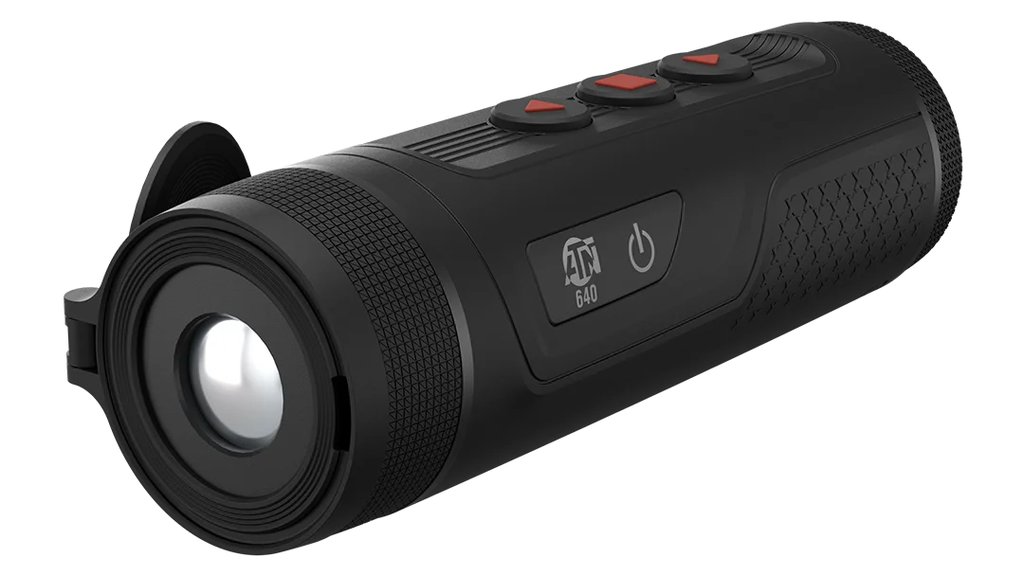
The ATN BlazeHunter XD is the AI thermal imaging system to buy when you want the most detailed handheld picture ATN builds. Its 1280x1024 sensor and 50mm lens combine for a sharp image that stays readable across the 2-16x zoom range and out to a 3400m detection distance. The <=15mK NETD keeps contrast strong when the air turns damp or foggy, and SharpIR AI cleans every frame before it reaches the Full-HD OLED display.
What the AI actually does for you
The value of the AI shows the moment you push magnification. Zoom is where thermal images normally fall apart, because enlarging a soft picture just makes the softness bigger. On the BlazeHunter XD, the extreme-definition sensor gives SharpIR enough detail to keep the animal's outline crisp as you zoom, so at the top of the 2-16x range you're still looking at a recognizable shape rather than a warm cloud. Add up to 8x digital zoom — which crops into the sensor and enlarges what's there — and the million-plus extra pixels are exactly what makes that crop stay usable. Use digital zoom as a final nudge to confirm what you're looking at, not to manufacture range.
Ranging built into the spotter
The BlazeHunter XD carries a built-in laser rangefinder — an eye-safe 905nm Class 1 laser that reads distance out to 1000m with +/-1m accuracy. That matters on a spotter because knowing the real distance to an animal changes how you plan the stalk or the shot. You put the reticle on the target, press range, and get a number instead of a guess, which across featureless ground in the dark is easy to get badly wrong by eye. Hot Point Tracking then pins a marker to a moving animal so your eye isn't hunting for it against a busy thermal background as it moves.
Battery and build for the long night
An AI system is only useful if it lasts the night it's built for. The BlazeHunter XD runs on removable dual 18650 batteries for 10+ hours of total runtime — swap a depleted cell for a charged one and you keep going, so a full dusk-to-dawn session doesn't hinge on finding a charger. It's rated IP67, so rain and heavy dew don't end the outing, and it records video and audio to 32 GB of internal storage so you can review a sighting or a stalk afterward. At 495 g without the battery it's light enough to carry all night on a strap without wearing on you.
Who it's for and who it's not
It's for the hunter or observer who wants the most detail money can put in a handheld — someone glassing big open ground, ranching acreage, or working animals at real distance who values a spotter that resolves what it finds. It's not for a first-timer who only needs to check a treeline at close range; that buyer is better served by a lighter, simpler monocular from the same thermal monoculars line and can move up later.
Best matching rifle optic: ATN ThOR 6 384
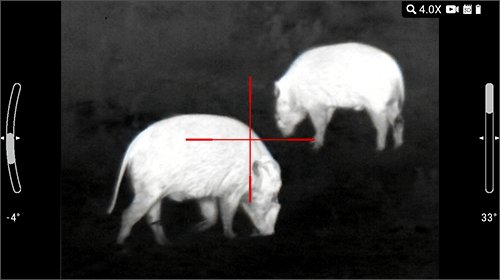
The ATN ThOR 6 384x288 is the rifle half of the system: you scan and range with the BlazeHunter XD, then shoot with the ThOR 6. It runs a 384x288 sensor at 2.5-20x with the same <=15mK sensitivity and the same SharpIR AI processing, so the picture through the scope shares the visual character of the spotter. Detection reaches 2300m, which is plenty for the shooting distances a handheld-plus-scope workflow actually produces.
Why pair a spotter and a scope
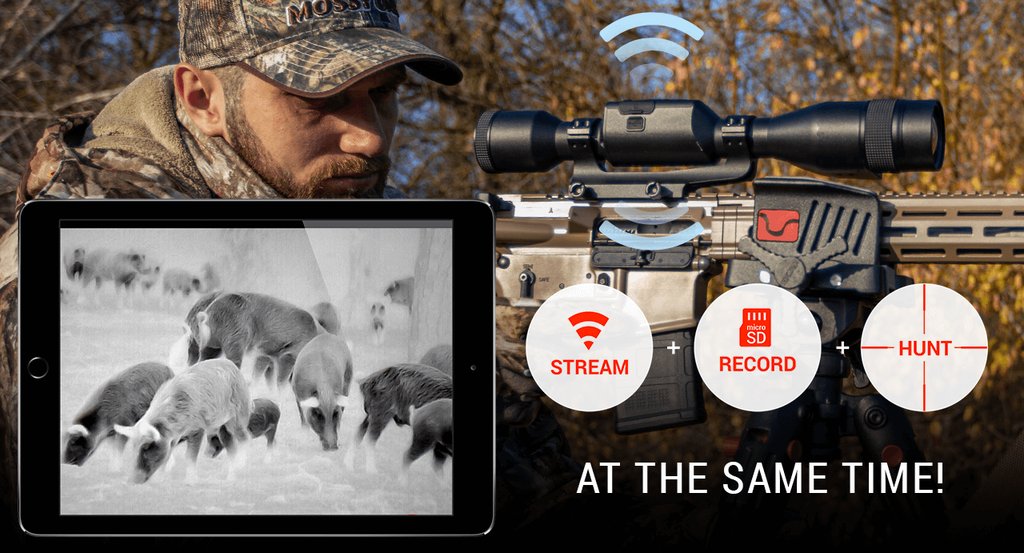
A dedicated spotter and a scope do different jobs, and running both is faster and safer than trying to do everything through a rifle-mounted optic. You sweep the ground with the BlazeHunter XD held to your eye — no rifle pointed at anything while you search — pick up heat early with its long detection range, range it, and identify it with the extreme-definition sensor. Only once you know what it is and how far do you bring the ThOR 6 up. The scope adds Recoil Activated Video to capture the shot, Picture-in-Picture for a magnified aiming window that keeps the wider scene visible, and Zeroing Freeze to make sighting in straightforward.
The trade against a one-optic setup
Running two devices costs more than a single scope and means two batteries to keep charged. The upside is a cleaner, safer workflow and a spotter that out-resolves anything mounted on the rifle. Who it's not for: a hunter on a tight budget who only takes close shots and would rather put everything into one capable scope. For them a single ThOR 6 covers both roles at short range.
How to choose an AI thermal imaging system
With the AI sensor sorted, the choices are about how you feed and use it. Two systems can both claim AI and perform nothing alike, because processing is only one link in the chain. A high-res core behind a small lens, a slow refresh, or a short battery throws away what the AI gains you. Judge the rest of the system honestly against how you actually hunt — the distances you really cover, the weather you're out in, and whether you need ranging. Weigh these in order:
- Sensor resolution — 1280x1024 is ATN's most detailed handheld core, giving SharpIR the most information to sharpen. More pixels means a recognizable shape deeper into the zoom.
- Lens size drives range — a 50mm objective gathers more infrared signal than a small lens, which is how the BlazeHunter XD reaches 3400m. Don't pair an extreme-definition sensor with a tiny lens.
- NETD sensitivity — lower mK means cleaner contrast in fog and humidity. The BlazeHunter XD sits at <=15mK, near the top of the line.
- Ranging — a built-in 1000m laser rangefinder turns a distance guess into a real number, which matters most on long, open ground.
- Refresh and display — 50 Hz keeps moving game smooth, and a Full-HD OLED display shows the AI-cleaned image at its best.
- Battery and build — swappable dual 18650 cells for 10+ hours and IP67 waterproofing are what let the system last a real night in the weather.
How we picked these ATN AI thermal imaging tools
We looked only at ATN's current 6th-gen line and judged its AI thermal tools on what lets the processing actually improve the picture. Resolution led — the BlazeHunter XD's 1280x1024 sensor gives SharpIR the richest detail to work on — but we weighed it alongside lens size, since a 50mm F/1.0 objective is what feeds an extreme-definition core enough infrared signal to reach 3400m; NETD, because <=15mK is what keeps contrast alive in damp air; the rangefinder, because a real distance number changes long shots; and battery and refresh, because a clean image is useless if it stutters or the device dies mid-night.
The honest trade-off is size, price and complexity. An extreme-definition spotter with a big lens and a rangefinder is a flagship instrument, and pairing it with a rifle scope means two devices to buy, carry and charge. That's not the right setup for everyone. This is an in-house comparison of ATN's own gear rather than an independent lab test, so treat these picks as our reasoned read of the current range and check the numbers against your own hunting — measure the 3400m detection range and the 2-16x zoom against the distances you truly cover, not the ones you'd like to. Who it's not for: close-range hunters who rarely stretch out, who would carry more resolution, weight and expense than their ground calls for, and who'd be better served by a simpler single monocular.
Frequently Asked Questions
What is the ATN BlazeHunter XD AI thermal imaging system?
It is ATN's flagship handheld thermal spotter, built around a 1280x1024 extreme-definition sensor with SharpIR AI image enhancement, a 50mm lens, a built-in 1000m laser rangefinder and 10+ hours of swappable battery. It delivers ATN's most detailed handheld thermal picture, out to a 3400m detection range.
What does the AI in the BlazeHunter XD actually do?
ATN's SharpIR AI works on the live image frame by frame, tightening the soft edges that thermal footage normally has so an animal reads as a defined shape rather than a glowing blur. With the 1280x1024 sensor feeding it more detail, the sharpening keeps outlines crisp even as you zoom in.
How far can the ATN BlazeHunter XD detect?
It has a 3400m detection range, thanks to the 1280x1024 sensor paired with a 50mm F/1.0 objective. Detection means picking up that heat is present; your identification and ranging distance will be shorter and depends on the animal's size and the conditions.
Does the BlazeHunter XD have a rangefinder?
Yes. It has a built-in laser rangefinder that reads distance out to 1000m with +/-1m accuracy using an eye-safe 905nm Class 1 laser. That gives you a real distance number instead of an eyeball estimate, which matters most on long, open ground in the dark.
How long does the BlazeHunter XD battery last?
It runs on removable dual 18650 batteries for 10+ hours of total runtime. Because the cells are swappable, you can carry charged spares and keep the system running through a full night rather than being tied to its internal charge.
Why pair the BlazeHunter XD with the ATN ThOR 6?
They cover the two halves of the job: you scan, range and identify with the handheld BlazeHunter XD, then shoot with the rifle-mounted ThOR 6. It's faster and safer than searching through a rifle optic, and the spotter out-resolves anything on the gun.
Is the BlazeHunter XD waterproof?
Yes, it carries an IP67 rating, so it handles rain and heavy dew. That, plus the swappable dual 18650 batteries, makes it built for long nights out in real weather rather than fair-conditions use only.
Want the most detailed handheld thermal picture ATN makes? The ATN BlazeHunter XD pairs a 1280x1024 sensor with SharpIR AI and a built-in laser rangefinder, so you find, range and identify game with real clarity. Pair it with an ATN ThOR 6 on the rifle for a spot-then-shoot workflow. See the full handheld range on the ATN thermal monoculars page and match the reach to the ground you cover.
Created: July 7, 2026 · 19:22:52 UTC